To design a membership product for recurring bookings, model the customer's ongoing commitment separately from each individual attendance. Protect the recurring place, show its state clearly, make exceptions deliberate, and design recovery for both the member and the operator.
That answer sounds simple because the customer’s intention is simple: “This is the thing I do every Tuesday,” “My child has this lesson each week,” or “This is the time I reserve for coaching.” The software underneath often turns that intention into a pile of separate transactions. The customer repeatedly books, cancels, searches, and confirms. Staff reconcile capacity, payments, attendance, exceptions, and messages in other systems. Both sides do work the product should have absorbed.
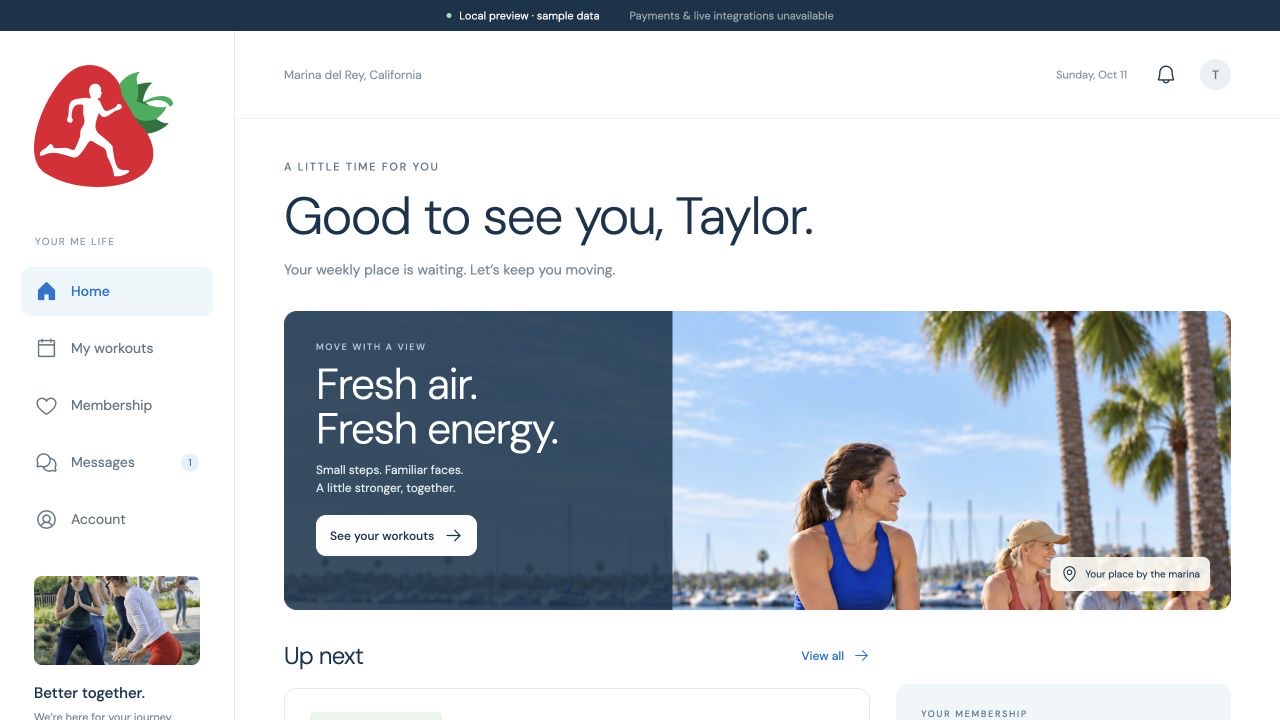
I encountered this problem while designing and building the public website and membership portal for ME Life, a Los Angeles fitness company. The public case study shows the result: a membership experience organized around recurring weekly places rather than a weekly scramble for availability. The useful lesson extends beyond fitness. It applies wherever a service is valuable because it becomes part of someone’s life: classes, lessons, coaching, care, clubs, maintenance, professional services, and many subscription businesses.
This article extracts the reusable product decisions from that work. It deliberately excludes ME Life’s private architecture, providers, customer data, internal thresholds, detailed operating rules, security configuration, and unreleased functionality. A framework should help another team think more clearly without exposing the implementation that belongs to the business.
The transaction trap
Many membership products begin as booking products. The first useful version answers an immediate question: which session is available, and can this person reserve it? That is a reasonable starting point. It becomes a problem when the product keeps treating every future interaction as if the relationship were new.
A recurring service has at least three layers of truth:
- The relationship: what the customer has joined, purchased, or committed to.
- The routine: what normally happens and which place, time, person, or entitlement should persist.
- The occurrence: what happened on a specific date, including attendance, substitutions, pauses, and cancellations.
When those layers are collapsed into one booking record, ordinary life becomes difficult to represent. A customer who misses one Tuesday may accidentally lose every Tuesday. A holiday may look like a cancellation. A pause may erase the routine the customer expects to resume. Staff may see an open space without knowing whether it is permanently available or available once.
The interface then compensates with explanations, support messages, and manual exceptions. That is a warning. If the product needs people to reinterpret the same ambiguous state repeatedly, the underlying model is probably asking one record to carry several different meanings.
A recurring membership is not a collection of purchases. It is an agreement about continuity, with individual occurrences inside it.
The Routine Product Framework
I use six connected decisions to design that continuity. They move from the promise the business makes to the evidence the product uses to improve. A team can enter the loop at any point, but it should be able to trace every decision around it.
1. Define the recurring promise
Start with the thing the customer expects to continue. It may be access, a protected place, a number of sessions, a service level, an ongoing relationship, or a result the provider helps sustain. State it without mentioning screens or features.
“Members can book classes” describes a capability. “Members have a reliable place in the workouts that fit their week” describes a relationship. The second statement forces better questions. How reliable is the place? What must the member do to keep it? What can change it? Does the promise concern a time, a coach, a location, a capacity entitlement, or some combination?
The promise becomes a test for later product decisions. If a workflow makes the customer recreate the commitment every week, the workflow contradicts the promise even if every button works.
2. Separate the commitment from attendance
The recurring commitment should survive an individual exception unless the customer or business deliberately changes it. That means modeling the ongoing place separately from the dated occurrence.
This separation prevents one missed session from silently rewriting the future. It also gives the operator a more honest view of demand. A person can hold a recurring place, attend this week, miss next week, use an approved alternative, or pause for a period. Those states affect capacity differently and should not be inferred from one ambiguous “booking status.”
The customer does not need to see the data model. They do need the benefit: confidence that a one-time change does not cause a permanent surprise.
3. Make state explicit to both sides
Recurring products accumulate state: active, scheduled, reserved, available, requested, confirmed, attended, missed, paused, ending, canceled. The exact vocabulary varies, but every word should have one meaning in the interface and the operating rules.
I avoid reassuring language that outruns the system. “Reserved” should mean the place is actually protected. “Requested” should not be styled as confirmed. “Canceled” should distinguish one occurrence from the recurring relationship when that distinction matters. A clean interface that hides this precision is not simple; it is vague.
Staff need the same truth. If the customer sees an active routine while the operator sees disconnected bookings, support becomes translation work. The two experiences do not have to show the same controls, but they should interpret the same state.
4. Treat exceptions as product paths
Exceptions are not edge cases in a recurring service. Travel, illness, holidays, instructor changes, capacity limits, payment issues, and schedule changes are part of the normal life of the product.
The design should distinguish three questions:
- Is this change for one occurrence or the ongoing routine?
- Who is allowed to make it, and when?
- What happens to capacity, payment, communication, and the next occurrence?
A useful exception path shows the consequence before the action. It preserves unrelated progress, explains what remains unchanged, and gives the operator enough context to help without rebuilding the customer’s story from messages.
5. Design recovery before optimization
A recurring relationship is damaged less by the existence of a problem than by an unclear recovery. If a payment fails, a session changes, or a provider is unavailable, the product should tell the truth about what is affected and offer the smallest safe next step.
Recovery can mean retrying, choosing an alternative, preserving a place while an issue is resolved, asking for help, or returning to a known-good state. The correct path depends on the business. The product principle is stable: do not make the customer repeat decisions the system already knows merely because one part of the process failed.
Recovery also protects perceived value. A premium promise is not proven by the ideal path; it is proven when the system remains coherent under pressure.
6. Measure continuity, not activity alone
Bookings, logins, messages, and completed payments describe activity. They do not by themselves show whether the membership is becoming a dependable part of the customer’s life.
The useful measures depend on the promise. A team might examine whether customers establish a routine, how often routine changes require support, how reliably exceptions recover, where ambiguity creates repeated contact, and whether staff and customer state disagree. These are categories of evidence, not universal metrics or claims about ME Life.
Good measurement returns to the product. If members repeatedly ask whether a one-time cancellation removes their future place, the answer is not only a better support script. It may be a state, language, or workflow problem. If staff repeatedly repair the same exception, the operating system is teaching the product what it has not yet learned.
The Routine Product Canvas
The canvas below turns the framework into a working session. Complete it with product, design, engineering, operations, support, and somebody close to the customer. Short, specific answers are more useful than polished statements.
Promise
What should continue without the customer reconstructing it?
- What is the customer committing to?
- What is the business committing to protect?
- What would break that promise?
Place
Which entitlement, time, person, capacity, or access should persist?
- What is recurring?
- What is specific to one date?
- When is a place held or released?
State
Which words describe the relationship, routine, and occurrence?
- What does the customer see?
- What does staff see?
- Where could the two disagree?
Exception
Which ordinary changes need deliberate paths?
- One time or ongoing?
- Who can change it?
- What else does the change affect?
Recovery
How does the product preserve continuity when something fails?
- What remains safe?
- What is the next action?
- When does a person take over?
Learning
Which evidence reveals friction in the relationship, not just activity?
- Where does support repeat work?
- Which states cause confusion?
- What should the next release improve?
Download the canvas as Markdown
Twelve questions for a recurring-service review
- PromiseCan we describe what continues without naming a feature?
- CommitmentDoes the product distinguish the relationship from one dated occurrence?
- PlaceCan the customer tell what is actually protected and for how long?
- StateDo customer and staff views interpret the same underlying truth?
- LanguageDo requested, reserved, active, paused, ending, and canceled each mean one thing?
- ScopeDoes every change make clear whether it affects once or from now on?
- CapacityCan the system distinguish a permanently open place from a temporary opening?
- ConsequenceDoes the customer see what will change before confirming an exception?
- RecoveryCan a problem be resolved without repeating decisions the product already knows?
- HandoffWhen a person helps, do they receive the relevant state and history?
- EvidenceAre we measuring continuity and repeated friction, not only transactions?
- LearningDoes recurring support work produce a product decision, or only another workaround?
The product is the continuity
A recurring-service company does not create value because it can process the same transaction many times. It creates value because the relationship makes something useful easier to sustain.
The product should carry that continuity. It should remember the commitment, protect the right thing, express the current state, absorb ordinary exceptions, and help the relationship recover when plans change. The customer should spend attention on the service itself—not on repeatedly operating the machinery around it.
That is the broader lesson I took from the ME Life work. Brand, interface, business rules, staff operations, and software architecture all participate in one promise. Product ownership is the work of keeping that promise coherent across the seams.
See the framework operating as a product.
Read the ME Life website and membership portal case study for the public journey, product screens, and the boundary between live surfaces and sample-data previews. Then read Brand is part of the product for the connection between promise, behavior, proof, and memory.