I was trained as a graphic designer before I became known as a software founder and product leader. That background taught me something I have carried through every company, interface, record, and live production I have built: people experience the whole thing.
They do not separate the product strategy from the typography, the support answer from the company voice, or the reliability of the system from the promise on the homepage. Those distinctions may be useful inside an organization, but they disappear at the edge where someone decides whether to trust, use, recommend, or pay for what we made.
This is why I think brand belongs inside product leadership. Brand is not a logo, and product is not a list of features. Both are ways of shaping an expectation and then deciding how the business will fulfill it.
That does not mean polish can rescue something useless. It cannot. A beautiful interface wrapped around a weak product may win the first click, but it makes the eventual disappointment sharper. The valuable work is coherence: making sure the real capability is understood, the experience expresses the right priorities, and the promise survives contact with reality.
Brand is expectation design
Every product creates expectations before a person uses it. Its name, category, price, language, visual identity, screenshots, reputation, and sales process all suggest what kind of experience is coming. Those signals answer questions people may never say aloud: Is this made for someone like me? Does this company understand the problem? Will the product respect my time? Can I trust it with something important?
A brand strategy is the deliberate answer to those questions. It defines what the product wants to be known for, who it is for, what it refuses to compromise, and which expectations it is willing to create. That is already product work because every promise has operating consequences.
If a company promises simplicity, the product cannot require a guided tour to complete a routine task. If it promises control, irreversible actions and hidden automation will feel like betrayal. If it promises expertise, vague language and shallow defaults will expose the gap. The stronger the promise, the more precisely the organization has to design for it.
The operating question
What must the product consistently do for the brand promise to remain true?
Perceived value is not imaginary value
“Perceived value” is sometimes treated as a polite term for making something look more expensive. I think that misses the point. People cannot inspect the architecture, intentions, and future of a product before choosing it. They need signals that help them judge the value already there.
Good design makes real value legible. It shows what matters first, explains what will happen next, reveals enough evidence to support a claim, and removes the noise that competes with the product’s strongest capability. A product can be technically excellent and still be undervalued because the experience fails to communicate why the excellence matters.
The opposite is also true. Presentation can temporarily inflate expectations beyond the product’s ability to deliver. That gap is brand debt. It eventually appears as poor retention, support friction, skepticism, discount pressure, or the feeling that the company is trying too hard. The goal is not to maximize perception independently of reality. It is to help people perceive the right value, then keep earning that perception.
The interface is where the promise becomes behavior
Interface decisions have brand meaning whether the team intends them to or not. A crowded screen says the company has not chosen what matters. An unexplained error says the internal system is more important than the person’s outcome. A destructive action without confirmation says speed mattered more than care. An honest progress state says the company is willing to distinguish what has happened from what it hopes will happen.
Typography, spacing, motion, color, and hierarchy contribute too, but not because every product needs to look luxurious. Their job is to direct attention and express character without interfering with the task. Restraint can communicate confidence. Density can communicate capability. Warmth can reduce intimidation. Precision can reinforce trust. The appropriate choice depends on what the product is and how the user needs to feel while using it.
My graphic-design training taught me to see these decisions as a system. Composition is not decoration; it controls sequence. Typography is not a font choice; it creates hierarchy and tone. Visual identity is not a collection of assets; it is a repeatable logic for recognizing the same idea in different contexts. The same discipline applies to software interfaces.
Brand should clarify product tradeoffs
Teams often describe brand as a set of flexible adjectives: innovative, human, powerful, easy. The words sound positive but rarely help when two good things conflict. A useful brand strategy has enough edge to make a choice.
Should the product expose advanced controls or make an opinionated default? Should it speak with institutional authority or approachable candor? Should it optimize for the fastest possible path or pause to create confidence before a consequential action? Should the interface feel energetic or calm?
There is no universal answer. The product leader’s job is to connect the answer to the audience, problem, and promise. “Easy” may mean fewer visible decisions for a consumer tool, while an expert tool may feel easier when it exposes more context and makes the system predictable. “Premium” may mean rich service in one market and radical restraint in another.
When brand is specific, it becomes a filter. A team can evaluate a feature, workflow, partnership, or message against the same intended position. When it is vague, every department produces its own version of the company and the customer receives the contradictions.
Trust is accumulated proof
Trust is not created by saying “trusted.” It accumulates through small pieces of evidence. The product remembers what it should. The bill matches the explanation. A status is precise. A person can understand why something happened. Support has the same context as the interface. A mistake can be corrected without beginning again.
Each interaction either supports or weakens the expectation the brand created. This is especially visible in products that handle complex or consequential work. The empty state, validation message, loading behavior, audit trail, escalation path, and recovery flow may do more for the brand than a campaign ever could.
This is where design, engineering, and operations have to meet. Design cannot promise clarity if the system does not preserve the information needed to explain itself. Engineering cannot promise reliability without observability and ownership. Support cannot provide continuity if the product hides the customer’s history. Brand coherence depends on architecture and operating decisions that may never appear in a brand guideline.
Design the four-part loop
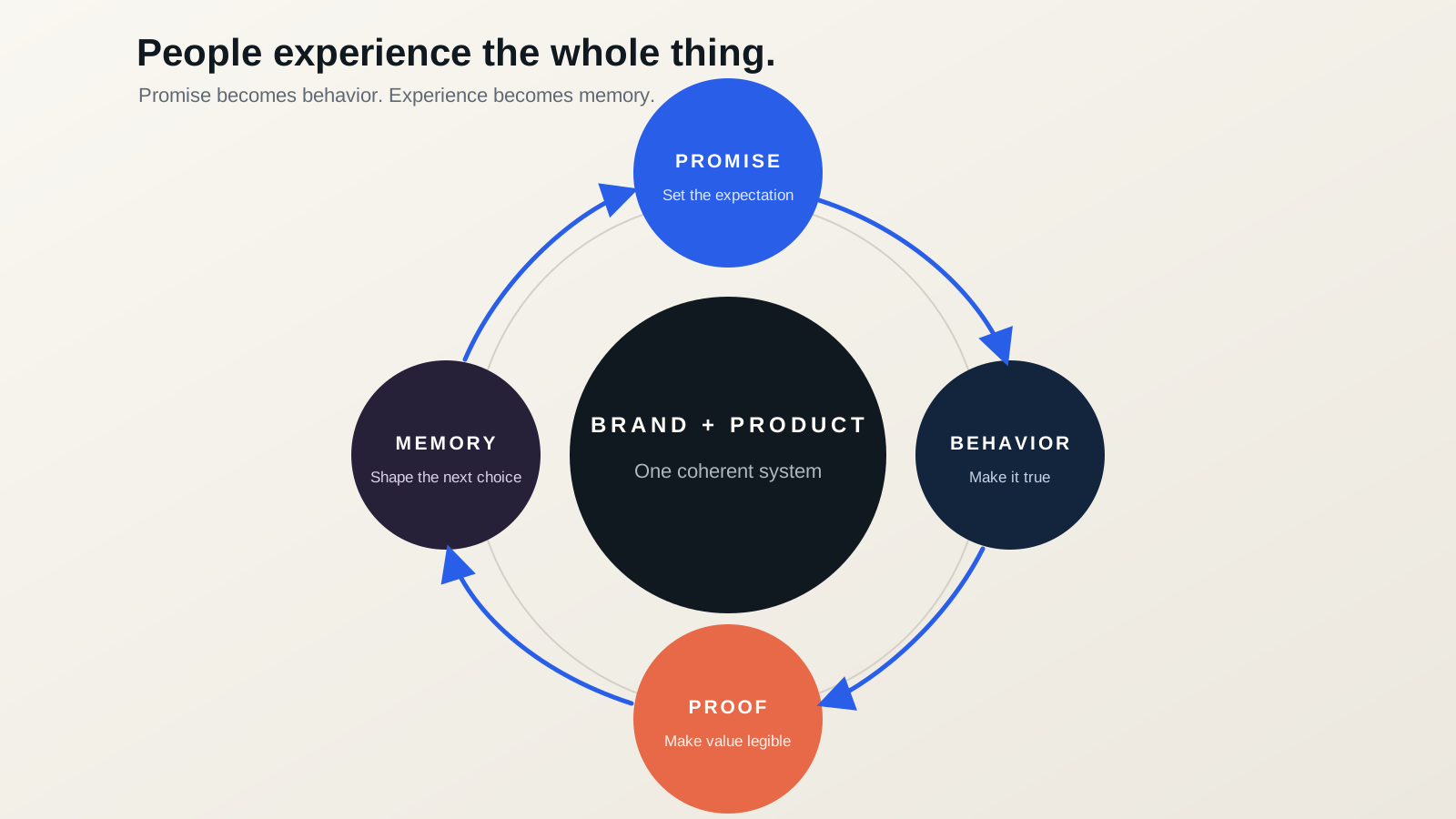
I use a simple loop to test whether brand and product are reinforcing each other:
- PromiseWhat should people expect, and why should they care?
- BehaviorWhich product and operating decisions make that expectation true?
- ProofWhat can a person see, understand, or verify while using the product?
- MemoryWhat feeling and story remain after the immediate task is complete?
The loop matters because memory shapes the next expectation. A person returns with more confidence, recommends the product in language the company could never manufacture, or warns somebody away. The brand that exists in the market is the accumulated result of those experiences—not the version approved in a presentation.
This also gives teams a practical diagnostic. If acquisition is strong but retention is weak, the promise and behavior may be misaligned. If customers succeed but struggle to explain the value, the proof may be hidden. If people appreciate the product but do not remember it, the experience may lack a distinctive point of view. Those are product and brand problems at the same time.
A design system should encode judgment
A design system is often reduced to reusable components. Components matter, but the higher-value system preserves decisions: how the product establishes hierarchy, communicates risk, handles uncertainty, asks for attention, and distinguishes a suggestion from a completed action.
The visual rules should connect to behavioral rules. A primary button should mean something is genuinely primary. A success state should appear only after success is confirmed. Color should not be the sole carrier of meaning. Motion should explain a change or reinforce character, not make the product wait for itself. Language should use the same degree of confidence as the underlying system.
When those judgments are encoded, consistency becomes easier without forcing every screen to look identical. Teams gain room to solve new problems while preserving the recognizable logic of the product. That is a stronger expression of brand than repeating a logo.
Brand also determines what not to build
Every addition changes the product’s center of gravity. A feature may satisfy a request and still make the overall product harder to understand. A partnership may expand distribution and weaken the position. A new audience may appear attractive while pulling the experience away from the people it serves best.
A strong brand creates useful constraints. It helps a team say: that is a real opportunity, but it is not ours; that capability belongs behind an advanced path; that message may produce clicks, but it teaches the wrong expectation; that shortcut would make the next release faster and the long-term product less credible.
This kind of refusal is not preciousness. It protects accumulated meaning. Products become distinctive through a sequence of coherent choices, including the choices to leave things out.
The product leader owns the seams
Organizations divide work because specialization is necessary. Customers encounter the seams because coordination is imperfect. The product leader has to keep asking whether the pieces still describe the same company.
Does the sales promise match the onboarding path? Does the pricing model reinforce the intended customer relationship? Does the support policy express the same priorities as the interface? Does the AI behave with the level of confidence the language implies? Does the back-office tool help employees deliver the experience the customer was promised?
This is one reason I am comfortable working across product, design, engineering, brand, and operations. I do not believe one person should replace specialists. I believe somebody must remain accountable for the relationships among their decisions. The seams are where perceived value is created or lost.
How I apply this in practice
I start with the problem and the audience, then write the promise in plain language. I identify the behaviors the product must perform consistently for that promise to be honest. I look for the moments where the user needs proof: evidence, status, explanation, control, recovery, or human help. Only then do I decide which visual and verbal qualities should make the experience recognizable.
I prototype the whole path early. A polished landing page beside a vague product flow is not a coherent prototype. Neither is a technically complete workflow with placeholder language and no information hierarchy. The useful prototype lets us feel whether the expectation, behavior, and evidence belong together.
I also test the edge cases as brand moments. What happens when the system is uncertain? When a process takes longer than expected? When the customer makes a mistake? When the company makes one? The recovery experience often reveals the real values of the product more clearly than the ideal path.
Finally, I listen for the language customers use when they describe the result. If their story is very different from the intended position, that is evidence. Sometimes the communication is unclear. Sometimes the product’s strongest value is not the one the team expected. Brand strategy should be disciplined, but it should not be deaf.
The standard is coherence
Strong branding does not mean making every product loud, expensive-looking, or emotionally elaborate. It means choosing a credible position and carrying it through the decisions people can experience.
The name introduces the expectation. The interface organizes it. The system behavior proves it. Operations sustain it. The memory becomes the brand.
When those layers agree, the product feels considered. People understand it faster, trust it for the right reasons, and can explain its value to someone else. When they disagree, no amount of surface polish can keep the contradiction hidden forever.
Brand is not everything in a business. But everything a business does teaches people what its brand means. That is why I design the brand and the product as one system.
Continue reading
For the interface and workflow principles behind capable software, read Building tools for experts. For the way I turn customer workarounds into product evidence, read From unmet need to working product.