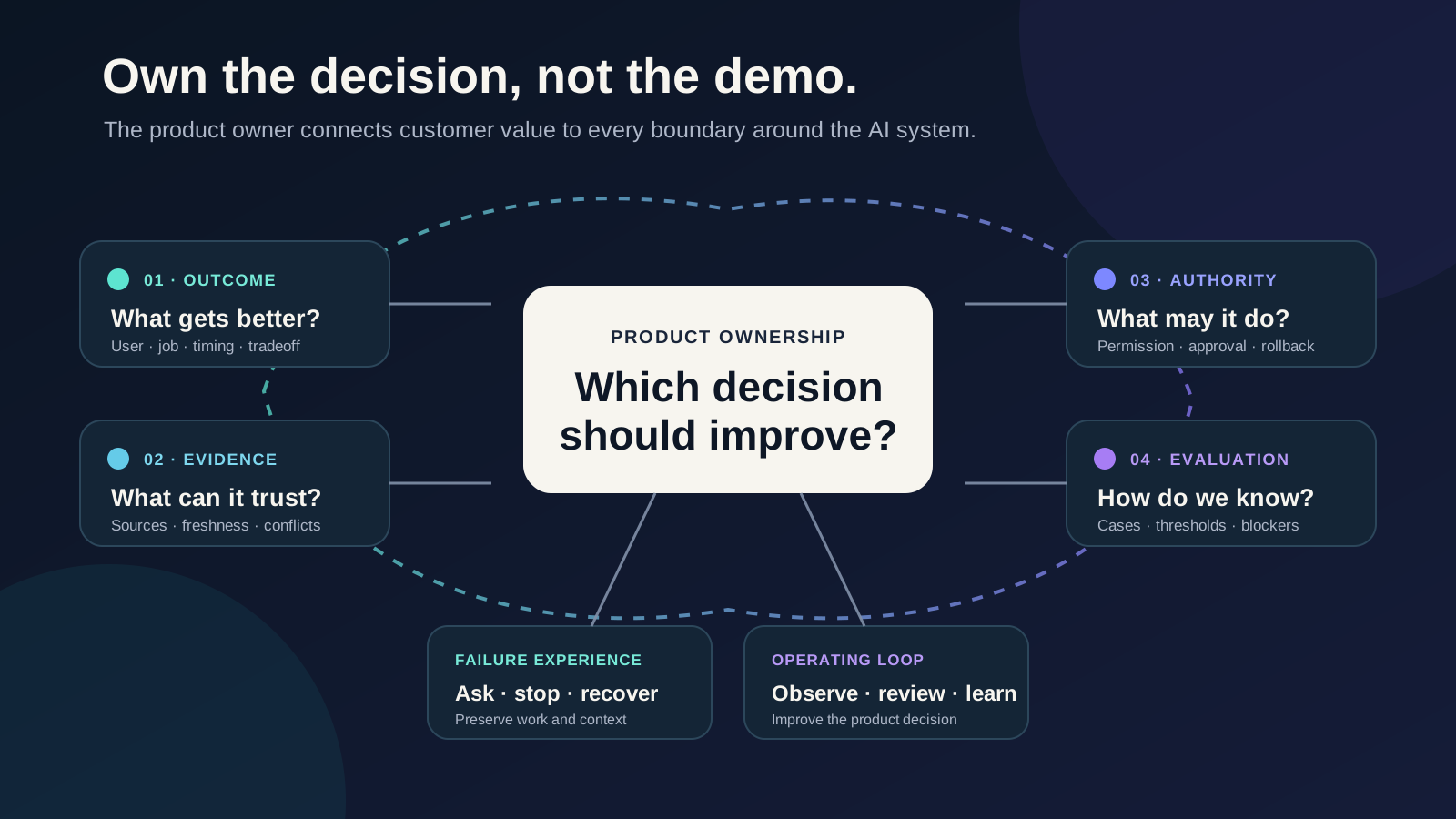
AI exposes weak product ownership quickly. If nobody owns the evidence, authority, failure path, and definition of success, a capable model can still create an unreliable product.
I have built AI into communications and operational products, including systems for fraud prevention, customer service, and voice generation. I am now applying the same product discipline while building CourtAhead and coordinating AI-assisted development. The domains differ, but the ownership problem keeps repeating.
The model is rarely the whole product. A useful AI system also needs the right context, business rules, permissions, interface, evaluation process, review path, operational ownership, and feedback loop. Product leadership is what keeps those parts aimed at one outcome.
This article describes that product discipline. It deliberately excludes private architecture, prompts, models, signals, thresholds, customer data, security controls, and unreleased product details. Those specifics belong inside the systems that use them. The framework is the reusable part.
Why AI product ownership is different
Traditional software can be difficult, but much of its behavior is deterministic. A well-defined input follows a path and produces an expected output. AI adds a component that can respond differently to inputs that look similar, fail fluently, and change when the model, context, or surrounding tools change.
That uncertainty changes the product owner’s job. Acceptance cannot stop at “the feature works.” The owner must decide what counts as working across a range of cases, what the system may do when confidence is low, and how the team will detect that quality has moved after release.
The familiar backlog is still useful. It is simply not the center of the role. The center is a set of decisions that several disciplines can implement and verify together.
The seven decisions an AI product owner must own
1. Own the customer outcome
“Add AI” is not an outcome. “Generate a response” is not necessarily one either. The customer may need an issue resolved, a risk reviewed, a document understood, or a decision prepared. The output only matters when it moves that job forward.
I define the outcome in terms that can survive a technology change. If the model were replaced next month, would the product goal still make sense? If not, the team is probably managing a capability instead of a customer problem.
This also clarifies what not to automate. A person may value a faster recommendation but still need to make the final decision. In that case, removing the person is not an improvement. It changes the product contract.
2. Own the decision the system is improving
An AI feature usually influences a decision, even when the interface presents it as text. A summary affects what someone reads. A ranking affects what gets attention. A generated reply affects what the company tells a customer. A risk score affects whether activity is allowed, delayed, or reviewed.
The owner should state that decision plainly. What is being decided? Who is affected? When must it happen? What is the cost of a wrong answer in each direction? Which consequences are reversible?
Once the decision is explicit, the team can choose the smallest useful role for AI. The model may extract facts, find related material, classify a case, propose an action, or perform a limited action. Those are very different levels of authority, even if they use the same underlying model.
3. Own the evidence
A polished answer can hide weak evidence. The owner needs to define which sources the product may rely on, how fresh they must be, and how the interface distinguishes a source fact from an inference.
Evidence quality is not only a retrieval problem. It includes missing context, contradictory records, stale policies, ambiguous account state, and data that should never have been available to the system. The product needs behavior for each condition.
I want the evidence close enough to the output that a user or reviewer can inspect it. That does not mean exposing private system internals. It means preserving a credible path from source to conclusion, appropriate to the person using the product.
4. Own the authority boundary
The product owner must decide what the system can do, not only what it can say. Can it send a message? Change a record? Approve a refund? Restrict an account? Prepare a filing? Each action needs an explicit authority rule.
Authority should narrow as consequence rises. Low-risk, reversible actions may be automated. High-impact or irreversible actions need stronger evidence, clearer permission, and often a person’s approval. “Human in the loop” is too vague unless the team knows which person, at what point, with what information, and with the ability to do what.
The fallback matters as much as the main path. The system should be able to ask, abstain, retry, limit the scope, or hand the work to the right person. A product that only knows how to answer will eventually answer when it should stop.
5. Own the evaluation contract
A demonstration proves that the system can succeed once. An evaluation contract defines what must remain true before and after release.
I use representative cases to estimate ordinary performance and challenge cases to expose known risks. They serve different purposes and should not be blended into one flattering number. The test set should include successful paths, ambiguous inputs, missing evidence, adversarial content, prohibited actions, and important failures the team has already encountered.
The measures have to follow the customer outcome. A support product should not count a closed conversation as a resolved problem without evidence. A risk product should not optimize model accuracy while ignoring legitimate customers delayed by false positives. A writing tool should not measure output volume while the user spends longer correcting it.
The owner also decides the release threshold. Which failures block release? Which require a warning, reduced scope, or manual review? Which are acceptable limitations that should be documented and monitored?
6. Own the failure experience
AI product design often spends too much time on the impressive answer and too little on the uncertain one. Production quality becomes visible when the input is incomplete, the tool fails, the evidence conflicts, the model times out, or the user disagrees.
A useful failure state tells the truth without abandoning the user. It preserves completed work, identifies what is missing, offers a safe next step, and avoids pretending that a partial result is final. If a person takes over, the handoff should carry the relevant context rather than forcing the customer to restart.
Recovery is part of the product contract. The owner should know who can correct a result, how an action is reversed, what history is retained, and how the correction improves future behavior.
7. Own the operating loop
AI quality is not fixed at launch. Inputs drift, customer behavior changes, policies move, model providers update, and the team adds tools or context. A system that passed its original evaluation can become less dependable without a visible failure.
The operating loop needs named owners and useful signals. Who reviews unusual cases? Who responds when a quality measure moves? Which product decision can reduce the failure rather than add another manual process? How quickly can the team limit or roll back the affected behavior?
Operational data should return to product decisions. If support repeatedly corrects the same misunderstanding but the evaluation set and interface never change, the organization is learning while the product is not.
A practical ownership map
I use a simple map to keep the work connected. Product owns the decisions in the middle column. Specialists supply judgment and implementation, but the product owner remains accountable for whether the pieces produce a coherent result.
| Product question | Owner must decide | Evidence of completion |
|---|---|---|
| What improves for the customer? | The outcome, affected user, timing, and acceptable tradeoffs. | A measurable success definition tied to the user’s job. |
| What decision changes? | The exact decision, consequence, reversibility, and role of AI. | A decision flow that includes uncertainty and exception paths. |
| What can the system trust? | Approved sources, freshness, conflicts, missing data, and explanation needs. | Traceable outputs and tests for absent or contradictory evidence. |
| What may the system do? | Permissions, approval points, limits, escalation, and rollback. | Enforced action boundaries and verified unauthorized-action tests. |
| How do we know it works? | Representative cases, challenge cases, measures, and release thresholds. | A versioned evaluation with results for the actual release candidate. |
| What happens when it fails? | User message, preserved work, handoff, correction, and recovery. | Tested failure journeys, not only logged exceptions. |
| How will it keep working? | Monitoring, review ownership, rollback, and the improvement loop. | Named response paths and regular review of real outcomes. |
This map also helps prevent accidental gaps between teams. Engineering can prove that a permission is enforced. Design can prove that uncertainty is visible. Operations can prove that a review reaches the right queue. Security can challenge the boundary. The owner connects those proofs to one product decision.
Twelve questions before an AI product release
I would not use the same process for every change. A copy adjustment and a new autonomous action do not carry the same risk. These questions scale the review toward the consequence:
- OutcomeCan we state what becomes better for the user without mentioning AI?
- DecisionWhich decision does the system influence, and who remains accountable for it?
- EvidenceWhich sources may it use, and what happens when they are missing, stale, or contradictory?
- AuthorityWhat can it recommend, prepare, or do, and where is that boundary enforced?
- UncertaintyCan it ask, abstain, narrow the task, or escalate instead of guessing?
- EvaluationDoes the release candidate pass representative and challenge cases tied to the real outcome?
- Critical failuresWhich result blocks release regardless of the average score?
- User recoveryCan a person understand, correct, and recover from a wrong result?
- Operational recoveryCan the team limit, disable, or roll back the behavior without waiting for a full rebuild?
- Privacy and securityDoes the system use the minimum data and authority required for the task?
- MeasurementWill production signals reveal customer outcomes rather than activity alone?
- OwnershipWho reviews failures, decides what changes, and verifies the next release?
The product owner does not replace specialist judgment
Owning a decision does not mean pretending to be the best model engineer, security specialist, designer, lawyer, support leader, or domain expert in the room. It means making sure their judgment reaches the product requirement and that a local optimization does not quietly change the customer contract.
For example, a model team may improve a benchmark while increasing latency beyond what the workflow can tolerate. Operations may reduce review time by removing context that reviewers need. Design may reduce friction around an action that should require deliberate confirmation. Each improvement can be real within one discipline and still weaken the product.
The owner keeps the complete decision visible. Specialists challenge the assumptions and provide the evidence needed to make it responsibly.
What good AI product ownership looks like
A well-owned AI product is easier to explain than a poorly owned one. The team can say what outcome matters, where AI helps, what evidence supports the result, what the system may do, how quality is evaluated, what happens when it is uncertain, and who responds when production behavior changes.
That clarity creates speed. Teams spend less time debating vague quality claims. Review focuses on the actual consequence. New model capabilities can be tested against an existing product contract instead of starting the strategy again.
The product owner’s most important artifact is a shared, testable definition of responsible behavior that remains useful after the demo. The backlog should follow from it.
Continue with the practical tools
Evaluate the whole AI system.
Read AI that survives contact with production, then use the AI support scorecard to compare verified outcomes instead of conversation closure.
For the development side, see Managing AI coding agents like a product team.