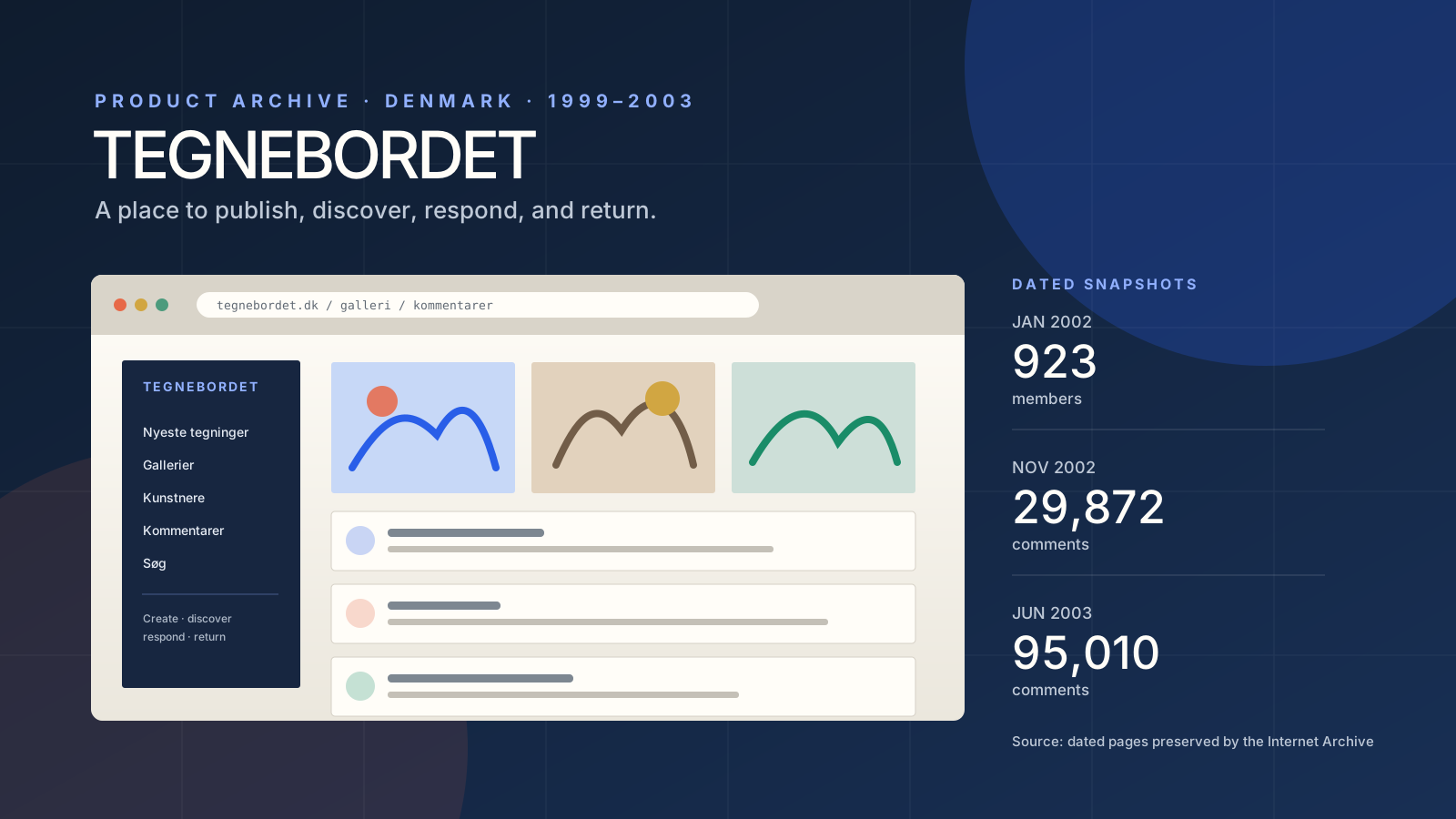
The vocabulary came later. We did not call it a creator platform, a user-generated-content product, a social graph, or a community flywheel. It was simply a place that needed to exist, so I designed and coded it.
Tegnebordet means “the drawing board” in Danish. By January 1999, the site was online. Its purpose was easy to understand: artists could create a profile, publish drawings, see work from other people, and respond with comments. That description sounds ordinary now because the behavior became normal. At the time, the web was still teaching people that a website could be a place they participated in rather than a page they visited.
I was a teenager in Brønderslev. I was also learning graphic design, working as a DJ, taking nightlife photos, and trying to understand what software could make possible. Period pages and product news under my Crapman username document that I coded and operated the site. This is not a polished founder story reconstructed twenty years later. It is the product speaking from the period when the work was happening.
What the archive actually proves
Product histories become cleaner with time. Launches turn into a date, a growth number, and a sentence about vision. The surviving Tegnebordet pages are more useful because they preserve the untidy operational reality: feature announcements, interface changes, moderation, advertising, search, galleries, profiles, counters, and a community producing far more activity than any one person could create.
Earliest root capture located in the Internet Archive.
3,292 drawings in the dated product snapshot.
Alongside 1,260 members and 7,949 drawings.
Alongside 2,965 members and 21,183 drawings.
Those numbers are snapshots, not marketing totals. That distinction matters. They do not prove an exact launch day or lifetime scale, and they should not be stretched into claims the archive cannot support. What they do show is more interesting: participation was compounding. By June 2003, the comment count was more than four times the number of drawings. People were not only uploading files. They were responding to one another.
The archived home page also documents continuing product work. News posts under my Crapman username describe improvements to search and galleries, changes to advertising administration, and the practical work of maintaining the community. This was not a portfolio I had built and abandoned. It was an operating product.
The site and the later business registration are separate milestones. The archive shows the product online by January 1999; Denmark’s business register records the Tegnebordet sole proprietorship under my full name in 2003. I do not use the registration date as the product launch date.
The product beneath the website
A community product has at least two layers. The visible layer is the interface: profiles, galleries, navigation, upload forms, comment boxes, search results, and the small signals that tell people what happened. Underneath it is a behavioral system. The product has to answer questions users may never consciously ask:
- Is my work welcome here?
- Will anybody see it?
- What kind of response should I expect?
- Can I trust the people and the platform?
- What makes me want to return?
A technically complete upload feature can fail every one of those questions. A beautiful gallery can fail them too. The actual product is the relationship between capability, expectation, and behavior.
That is one reason my graphic-design background and technical work have never felt separate. Visual hierarchy tells a person what matters. Language tells them what the system expects. Interaction design determines whether contributing feels safe or risky. Code turns those decisions into consistent behavior. Brand establishes the promise connecting all of it.
When those disciplines are divided too early, a product often becomes a relay race. Strategy hands something to design, design hands screens to engineering, and engineering hands a build to operations. Context disappears at every exchange. On Tegnebordet, the distance between an observed problem and a product change was extremely short. I could see the behavior, decide what the interface needed to communicate, change the underlying logic, and watch what happened next.
Design the loop, not only the screen
The core loop was simple: make work, publish it, receive a response, discover somebody else, and respond in turn. Each step supplied energy to the next one. Publishing created something to discover. Discovery created a reason to comment. A useful comment created a reason for the artist to return. Returning increased the chance of another contribution.
That sounds obvious when written as a loop. It is easy to damage in a real product. If discovery repeatedly favors the same people, new contributors learn that publishing is pointless. If feedback is hostile or empty, the creator learns that exposure is not worth the cost. If notifications are unclear, the response never completes the loop. If uploading requires too much effort, there is nothing new for anybody else to find.
This remains true in business software. The nouns change, but the structure survives. A customer enters information, the system turns it into a useful outcome, somebody else acts on it, and the result creates confidence in the next action. Product teams sometimes optimize an isolated screen while the surrounding loop is broken. A faster form does not help if nobody trusts the decision that comes out of it.
Repeated comments also carried a kind of product intelligence. They revealed what the community noticed, which work attracted attention, where language became confusing, and what behavior required intervention. Modern teams may call this qualitative data. To me, it was simply the closest available view of whether the product was alive.
Moderation is architecture
Any product that invites participation also creates obligations. People need boundaries, reporting paths, predictable consequences, and some confidence that the environment will still make sense tomorrow. Moderation is often described as a policy function added after a community grows. In practice, it is part of the product architecture from the beginning.
The interface shapes moderation before a moderator takes action. What can be posted? Who can respond? Which identity is visible? How is a problem reported? What context does the reviewer receive? Can an action be reversed? Does the affected person understand what happened? Every answer changes both user behavior and operational cost.
The archived Tegnebordet material shows that moderation became a real community role, not only a founder task. That is a sign of scale, but it is also a product transition. Founder judgment has to become a system other people can apply. The same transition appears in growing software companies: exceptions once handled through personal context have to become explicit rules, tools, permissions, audit trails, and escalation paths.
Automating that transition carelessly creates a different failure. Rules become rigid, unusual cases are treated as identical, and users cannot reach a person when the system is wrong. The goal is not to remove judgment. It is to place judgment where it creates the most value and give it enough context to be fair.
Scale changes the product you thought you built
A product with a few hundred participants can depend on shared context and direct founder involvement. A product with thousands of members and tens of thousands of contributions cannot. Search matters more because browsing everything is impossible. Taxonomy matters because people need meaningful paths through the work. Reliability matters because more people are depending on the system at different times. Abuse prevention matters because the value of disrupting the community increases with its visibility.
Operations become part of the user experience. Slow pages change what people view. Broken image handling changes what they publish. Weak administrative tools change how quickly problems are resolved. A confusing advertising workflow affects the resources available to run the service. None of those systems sits outside the product merely because most users cannot see it.
I still think about back-office software this way. If employees need five systems, a private spreadsheet, and one person’s memory to deliver the customer experience, the hidden product is carrying structural debt. Eventually that debt appears in speed, reliability, support quality, price, or trust.
The community escaped the boundaries of the site
The strongest evidence of a community’s value is not what the founder says about it. It is what other people do because it exists.
In 2005, a contemporary Serieland analysis placed Tegnebordet first among the Danish drawing and comics sites it examined and described it as clearly the most visited drawing-related site in that comparison. The method relied partly on sampled Alexa data and was debated in the same thread, so it should not be presented as an audited traffic ranking. It is still valuable as period evidence: people in the field saw Tegnebordet as an important part of the Danish digital drawing landscape.
A 2007 publication from the Danish Cultural Heritage Agency went further. It used Tegnebordet as an example of children, young people, and adults gathering around uploaded art, commenting on work, and participating in a cross-generational community.
That is the moment a digital product becomes more than its feature set. It gives people a new behavior, role, relationship, or opportunity that continues outside the interface.
Brand was part of the coordination system
“Tegnebordet” was a practical name. It described a familiar creative surface while leaving room for many kinds of people and work. The identity did not need to explain every feature. It needed to make the place legible and give participation a coherent frame.
That is what strong product brands do. They reduce the amount of explanation required before somebody can form a useful expectation. The interface, language, visual identity, moderation and community behavior then have to keep the promise. If the brand says “serious tool for creators” while the product feels careless, perceived value collapses. If the product is capable but the identity makes it look unreliable, users may never stay long enough to discover the capability.
Branding is therefore not decoration applied after product-market fit. It is one of the systems through which a product establishes meaning and trust.
What still holds up
The technology behind Tegnebordet belongs to another era. The product lessons do not.
- Begin with a behavior worth enabling.A product idea becomes clearer when you can describe what people will be able to do—not merely what the software contains.
- Design the complete loop.Contribution without discovery, automation without inspection, or output without a next action is only a partial product.
- Treat feedback as part of the system.Response creates learning for the user and evidence for the product team. Make it useful, visible, and safe.
- Build trust operationally.Moderation, permissions, reliability, reversibility and support are product capabilities, not administrative overhead.
- Watch what escapes the interface.The deepest value may appear in relationships, workflows and opportunities users create beyond the feature you shipped.
- Keep design close to implementation.The shorter the distance between observed behavior, interface judgment, technical constraints and operational reality, the less meaning is lost.
Looking back, I do not see a straight line from Tegnebordet to every product I built afterward. Careers are rarely that neat. I do see the same instinct repeating: notice a missing tool, make the first usable version, stay close to the people using it, and keep expanding the system until the hard work becomes easier to understand.
That pattern later appeared in music and label operations, media software, cloud communications, production AI, and live creative environments. The industries changed. The work remained product work.
Sources and archive notes
This case study uses dated public artifacts rather than later directory biographies wherever possible. External pages may preserve period language or personal details that are not repeated here.
- Tegnebordet home page, captured November 26, 2002 — product news and dated community snapshot.
- Tegnebordet home page, captured January 20, 2002 — earlier dated community snapshot.
- Tegnebordet home page, captured June 13, 2003 — later dated community snapshot.
- Danish CVR listing for Tegnebordet v/Peter Rank Schrøder, CVR 26949645 — registration evidence for the 2003 sole proprietorship, distinct from the earlier website launch.
- “Det digitale Tegneserie-Danmarks top 33,” Serieland, April 3, 2005 — contemporary comparison and discussion of Danish drawing sites.
- “Generationskløften,” Serieland, 2008 — discussion of young Danish artists growing up with Tegnebordet and DeviantArt.
- “Digital kulturformidling – børn og forskere har ordet,” Danish Cultural Heritage Agency, 2007 — institutional discussion of Tegnebordet as a cross-generational creative community.
Archive counts describe what the cited pages displayed on specific capture dates. They are not represented as audited traffic, present-day data, or lifetime totals.
Continue reading
From unmet need to working product
How workarounds become evidence, prototypes become systems, and direct customer exposure creates better product judgment.
Read the product essay →